Before skyscrapers
For most of history, the tallest things people built were not buildings. Cathedrals, pyramids and towers were monuments, and the tallest habitable structures were limited by the simple fact that nobody wanted to walk up more than a few flights of stairs. The tall building as a type had to wait for two inventions: a safe, practical passenger lift, and a structural frame that separated the building’s weight from its walls. [1] [2]
Both arrived in the late nineteenth century. The Home Insurance Building in Chicago, completed in 1885 and often described as the first skyscraper, used a metal frame to carry much of its load, and the spread of the electric lift made upper floors worth renting. Once height became commercially valuable, the race began. [3] [1]
Before the frame, height was limited by the thickness of load-bearing walls. A masonry building has to grow heavier as it grows taller, and its walls must thicken at the base to carry the weight above, which consumes floor space and eventually makes the building uneconomic. The framed structure broke that limit by carrying load in a skeleton, and everything about the modern tall building follows from it. [2] [1]
New York and Chicago
For decades the record moved back and forth between Chicago and New York. As steel frames and wind bracing improved, buildings climbed steadily: the Woolworth Building reached 241 metres in 1913, a Gothic tower that showed a tall building could also be a piece of civic architecture. Each new record was modest by modern standards, but each one taught engineers something about wind, stiffness and the cost of going higher. [4] [1]
The race was as much an economic contest as an engineering one. Cities and companies used height to advertise themselves, and a brief spell at the top was worth a great deal of publicity. That mix of pride, money and engineering skill has driven the title ever since. [1] [2]
The early records were short-lived because each new tower was only a little taller than the last, and the technology was advancing quickly. Steel frames, riveted connections, wind bracing and faster lifts all improved together, so a building that set a record in one decade could be surpassed in the next by a competitor using the same city’s skills and capital. [1] [4]
The 1930s race
The most famous chapter of the race played out in Manhattan in 1929 and 1930. Two projects, 40 Wall Street and the Chrysler Building, raced to be the tallest, and the Chrysler Building won when its stainless-steel spire was raised in secret and dropped into place. It was overtaken almost immediately by the Empire State Building, completed in 1931, which reached 381 metres and would hold the record for four decades. [5] [6]
The Empire State Building was built during the Great Depression with astonishing speed, and its height was part engineering, part spectacle. For most of its early life it struggled commercially, which showed that being the tallest did not guarantee being the most profitable. Height and success were never the same thing. [6] [1]
The 1930s also produced the first strong public association between height and civic identity. A tower could be seen from everywhere in a city, and its silhouette became a logo. That association explains why height records have always been pursued by institutions, governments and companies as much as by engineers. [6] [5]
Twin towers and Sears
The next leap came in the 1970s. The World Trade Center towers in New York, completed in 1972 and 1973, used a framed tube and became the tallest buildings in the world. They were quickly overtaken by the Sears Tower in Chicago in 1974, whose bundled tube structure and stepped profile reached 442 metres and held the title for more than twenty years. [7] [8]
The Sears Tower era is important because the structure, not just the height, was new. The nine-bundle tube made a supertall tower practical in steel, and it showed how a building could taper and step back to reduce wind loads. Many later towers borrowed the idea. [9] [8]
The twin towers had demonstrated a different lesson, that a framed tube could give very large floor plates with relatively few internal columns. Together, the New York and Chicago towers of the 1970s established the two structural ideas that dominated tall building design for the next two decades. [7] [10]
Petronas and the spire decision
In 1998 the Petronas Towers in Kuala Lumpur were declared the tallest buildings in the world, displacing the Sears Tower. The decision turned on the definition of height: the Malaysian towers reached 452 metres including their spires, which were counted as architectural elements, while the Sears Tower’s taller antenna was not counted. It remains the clearest example of how a record can depend on rules rather than on steel. [11] [12]
The decision was contested at the time and changed how the industry discussed height. It made the measurement categories that still govern the record, including the distinction between architectural top and tip, part of everyday conversation among engineers, developers and the public. [11] [1]
Taipei 101 and the 2000s
Taipei 101 took the record in 2004 with a height of 508 metres including its spire, and it was the first building to pass the half-kilometre mark. It also introduced a very visible answer to wind and earthquake motion, a large tuned mass damper near the top, and a distinctive stacked-box form that resists typhoon winds. [13] [1]
By the 2000s the geography of the race had shifted decisively. The tallest buildings were no longer being built in the cities that had invented the type, but in Asia and the Middle East, where rapid urban growth and national ambition funded new records. [1] [2]
This shift also changed the engineering challenge. Tall towers in Taipei, Kuala Lumpur and Dubai had to be designed for typhoons, earthquakes and extreme heat, and the solutions they developed, from tuned mass dampers to tapering forms and buttressed cores, fed back into the global practice of tall building design. [13] [14]
Burj Khalifa and the megatalls
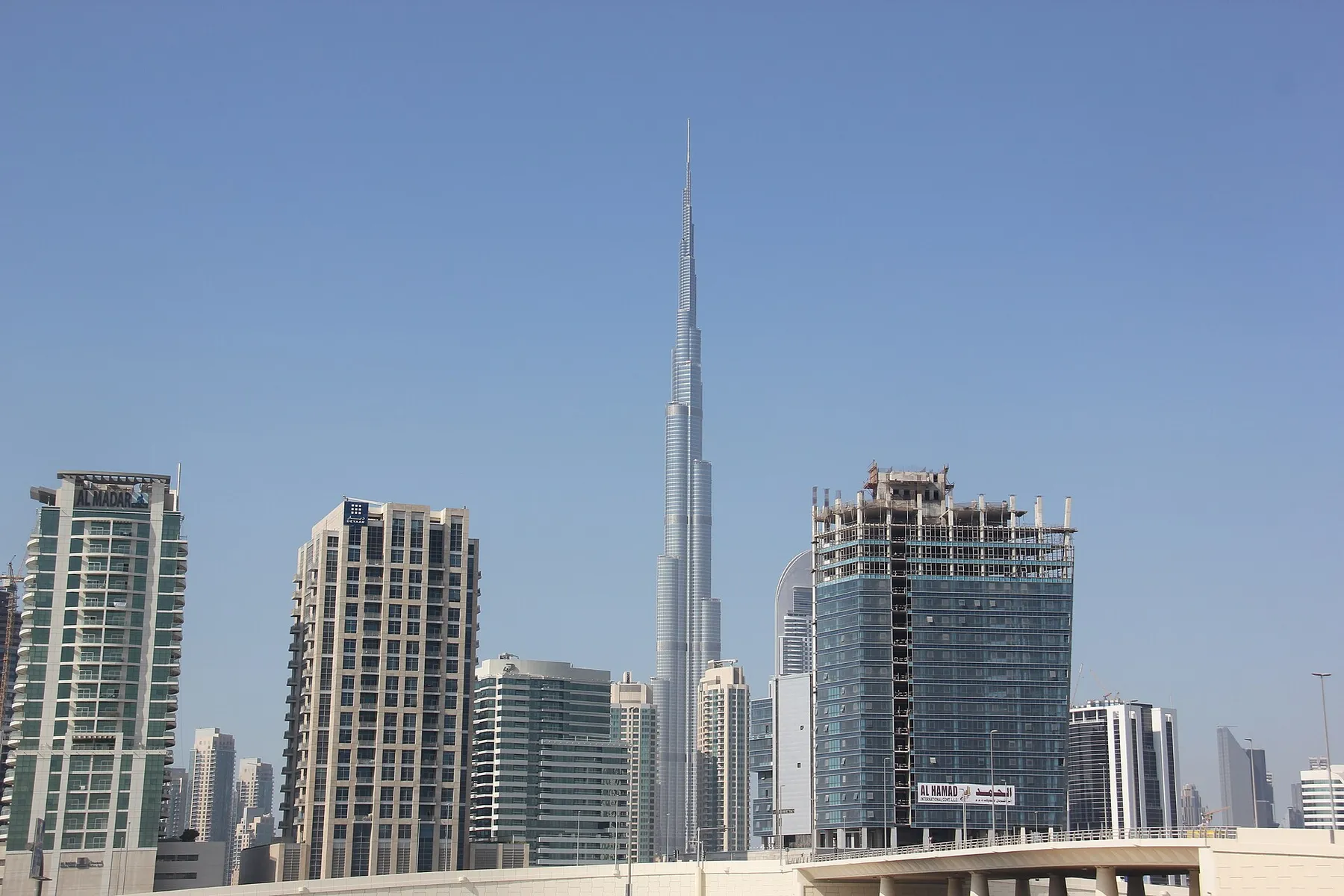
Burj Khalifa opened in Dubai in 2010 at 828 metres, a jump of more than 300 metres over the previous record and the first building to exceed 700 metres. Its buttressed core, tapering form and mixed-use programme set a new template, and the tower became the clearest symbol of the megatall era. [15] [14]
Since then the field has broadened. Merdeka 118 in Kuala Lumpur reached 678.9 metres on completion, becoming the second-tallest building in the world, while Jeddah Tower in Saudi Arabia is designed to pass the kilometre mark. The race has not ended; it has simply become more expensive and more geographically spread. [16] [17]
The cost of a record has risen with the height. A megatall tower needs deeper foundations, larger cores, stronger materials and longer construction programmes, and the gap between one record and the next is now measured in hundreds of metres rather than metres. That is why the next record is likely to be a single, exceptional project rather than the outcome of a close race. [17] [15]
Structures versus buildings
It is worth remembering that buildings are not the tallest things people have built. Broadcast masts, observation towers and guyed structures have exceeded the height of the tallest building for decades, and the tallest free-standing structure has often been a tower rather than a building. Records for buildings and records for structures are kept separately for this reason. [18] [1]
The distinction matters because a building must carry people, services and floors, while a mast or observation tower does not. The engineering, the cost and the usable height are quite different, and confusing the two is one of the most common errors in popular accounts of the height race. [18] [12]
Takeaways
The height record has moved from Chicago to New York to Kuala Lumpur to Taipei to Dubai, and each transfer reflected both new engineering and new economic power. Two inventions, the safety lift and the framed structure, made the skyscraper possible in the first place. [1] [3]
The rules have changed as often as the record. The Petronas Towers decision made the definition of height a permanent part of the story, and the megatall era has made the gap between architectural height and usable height a central question. [11] [19]
Sources & references
Sources reviewed 16 September 2026. Undated guidance and product pages can change. Dated research and announcements retain their original context; technical principles do not substitute for locally adopted project standards.
- Wikipedia. History of the world's tallest buildings.Accessed September 2026.
- Wikipedia. Skyscraper.Accessed September 2026.
- Wikipedia. Home Insurance Building.Accessed September 2026.
- Wikipedia. Woolworth Building.Accessed September 2026.
- Wikipedia. Chrysler Building.Accessed September 2026.
- Wikipedia. Empire State Building.Accessed September 2026.
- Wikipedia. World Trade Center (1973 to 2001).Accessed September 2026.
- Wikipedia. Willis Tower.Accessed September 2026.
- Wikipedia. Bundled tube.Accessed September 2026.
- Wikipedia. Framed tube.Accessed September 2026.
- Wikipedia. Petronas Towers.Accessed September 2026.
- Wikipedia. Council on Tall Buildings and Urban Habitat.Accessed September 2026.
- Wikipedia. Taipei 101.Accessed September 2026.
- Wikipedia. Buttressed core.Accessed September 2026.
- Wikipedia. Burj Khalifa.Accessed September 2026.
- Wikipedia. Merdeka 118.Accessed September 2026.
- Wikipedia. Jeddah Tower.Accessed September 2026.
- Wikipedia. List of tallest buildings and structures.Accessed September 2026.
- Wikipedia. Vanity height.Accessed September 2026.